

Over several decades, the U.S. swine industry has made progress in disease control through the transition from traditional farrow-to-finish farms to multi-site production. Along with segregated early weaning, many bacterial pathogens were eliminated from large parts of the industry. Air filtration, the application of feed mitigants, intensified front-door biosecurity, and a critical focus on transportation biosecurity have been key to maintaining the ever-improving health of the U.S. sow herd.
These are, in many ways, examples of small things done exceptionally well. Incremental improvements have delivered a big impact over time. Yet despite these advances, PRRS continues to gore our ox.
Perhaps it is time to reconsider another “small” factor that has largely remained out of focus throughout this evolution: where we place our sow farms.
The modern sow farm is not simply a breeding unit. It is a biological distribution center. Every week, thousands of pigs leave the typical sow farm and are dispersed across a network of grow-out sites. When a sow farm becomes infected with PRRS, the consequences extend far beyond the farm itself. Infected pigs are transported across counties, states, and production systems, creating a residual effect that can persist long after the initial outbreak.
In many ways, sow farms located in highly pig-dense regions become inadvertent multipliers of disease risk. Even when operating excellent biosecurity programs, these farms exist in environments where the probability of infection remains elevated. The result is a cycle in which breaks occur more frequently, and each break has the potential to impact a large number of downstream sites.
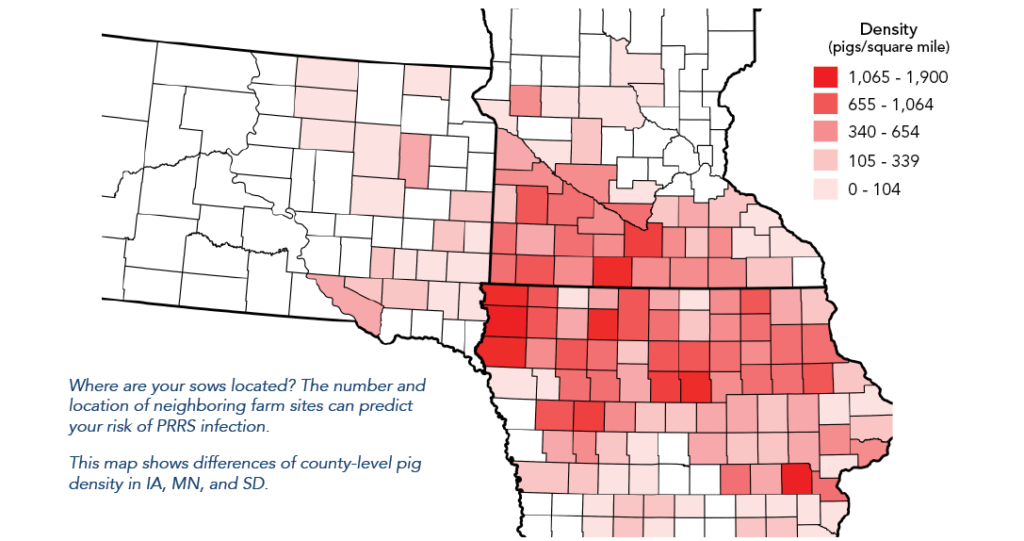
The industry has responded with increasingly sophisticated solutions, all of which have reduced the risk of infection. These measures are valuable and necessary. However, they primarily address the question of how to protect a sow farm, not where those sows are located or the broader implications of that decision.
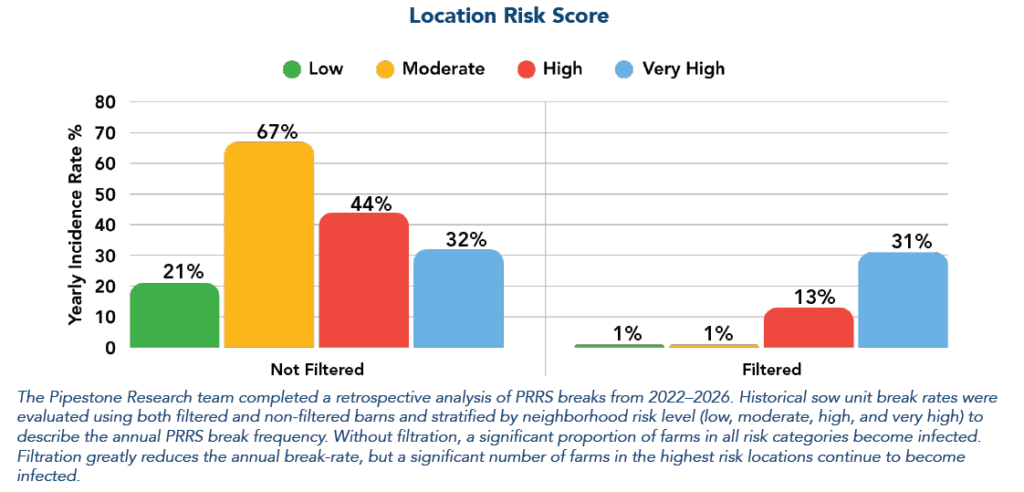
Tobler’s First Law of Geography states, “Everything is related to everything else, but near things are more related than distant things.” Said simply, your disease will be similar to that of your neighborhood.
The Case for Location-Based PRRS Control
Experience continues to demonstrate that geography matters. Sow farms located in lower-density regions generally experience fewer PRRS introductions than those in the heart of major swine production areas. A recent analysis of neighborhood density and PRRS infection rates clearly showed that “very high risk” locations break repeatedly with PRRS, and new infections occur despite biosecurity measures (such as air filtration). Sow farms that repeatedly break with PRRS will disseminate the virus with every weaning, infecting other sows in risky locations.
This is where the theme of small things creating big impact becomes especially clear. The simple decision of where a sow farm is located, often made once and then lived with for decades, can profoundly influence health stability, downstream risk, and system-wide disease pressure. The concept is simple: safe sows will move the industry forward.
As the industry continues to expand and modernize, future sow farm placement should become a more prominent part of disease-control discussions. Regions with lower pig density may offer opportunities to reduce long-term disease pressure while improving herd stability and production efficiency. A true win-win.
The swine industry has spent years focusing on biosecurity protocols, filtration systems, transportation practices, and vaccine strategies. Those efforts should continue. But the next major improvement in PRRS control may not come from a new technology or another protocol. It may come from recognizing that one of the most important disease-control decisions we make is also one of the most foundational—farm location.