Building on Faith and Family at JRT Focus Farms.
On a quiet stretch of northwest Iowa farmland, the story of JRT Focus Farms wasn’t built all at once. It came together layer by layer—slowly, intentionally, and as a family. Ask them how it all started, and the answer is simple: “Just a little here, and a little there.” It is a phrase their father repeated often, one that has come to define not only how the farm grew, but how the family built a life around it.
One Step at a Time
Long before JRT Focus Farms looked like it does today, the land was worked by their grandfather. In the 1970s, his son, Roger Knoblock, began building on that foundation, starting small with hogs and cattle. There were no big leaps, just steady progress. A barn here. A few more head there. Every step built on the last one.
At the same time, Roger and his wife, Janet, were raising their family. Before long, their eight children became part of the operation. When the farm formally incorporated in 1990, it gave structure to the family farm they had built. As the operation grew, so did the involvement of the next generation. While some returned right away and others later on, the opportunity was always there. “Our dad gave us an opportunity,” says son Travis Knoblock. “And that’s what allowed us all to come back.”
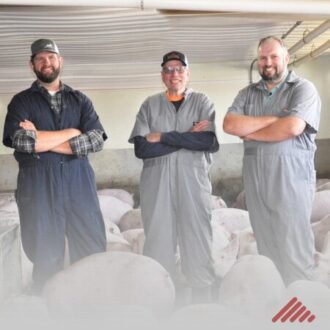
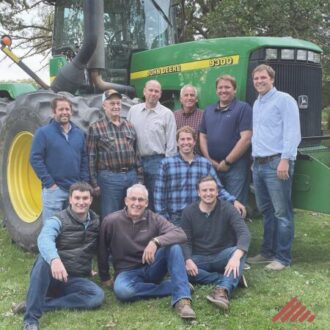
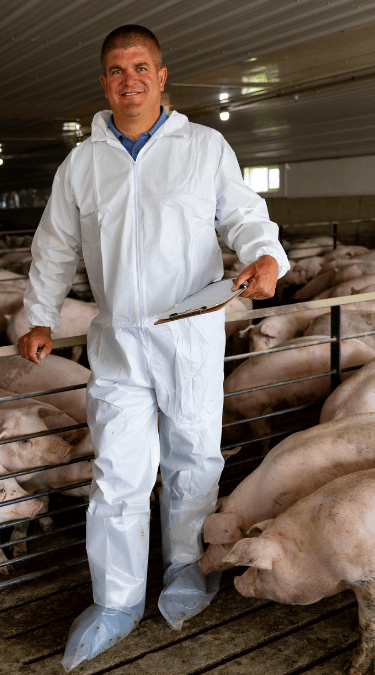
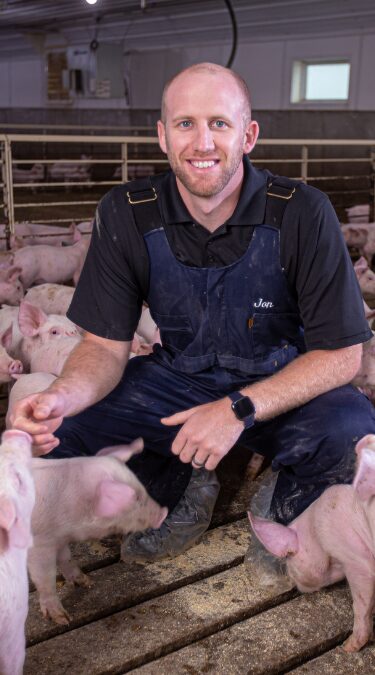
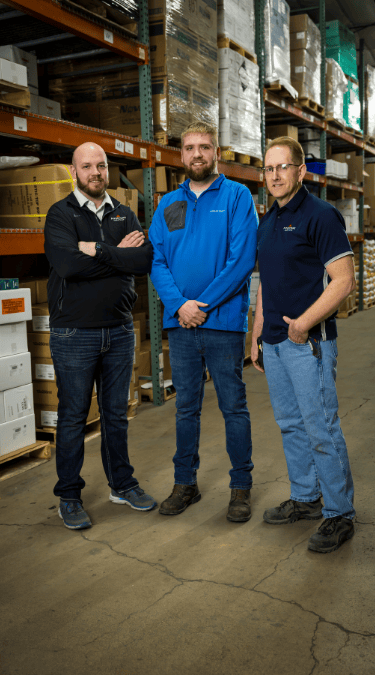
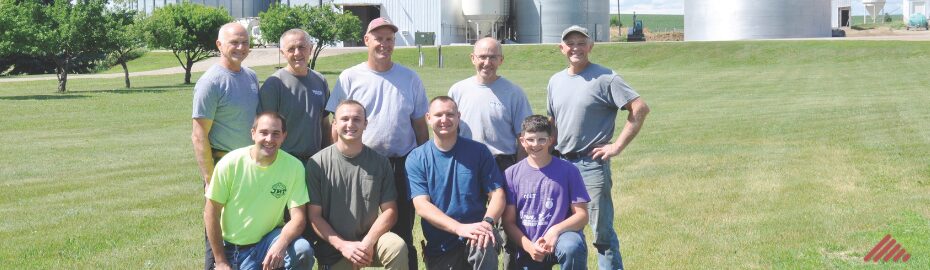
Today, the third generation—brothers Thadd, Trent, Troy, and Travis, along with their brother-in-law Jon—carry the operation forward, continuing to build on the foundation Roger and Janet started. Now, that same opportunity is being passed down again. A fourth generation is stepping in, with Chad, Kerrick, Korey, and Mathias returning home and beginning to take on ownership roles. Behind them, a fifth generation is already growing up on the farm, watching, learning, and getting their start the same way their fathers did.
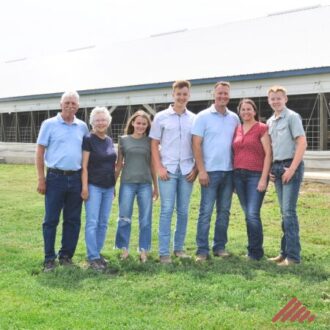
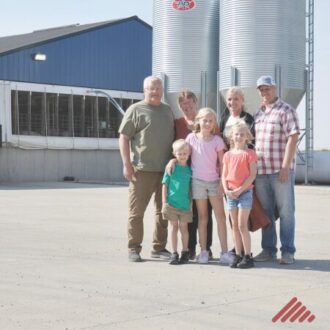
Roger and Janet’s family has grown to include 32 grandchildren and 11 great-grandchildren—a testament not only to their legacy, but to a farm that has always been more than just work. “We all have different responsibilities and areas of expertise,” Trent explains, “but we’re always working toward the same goal.”
Earning It Early
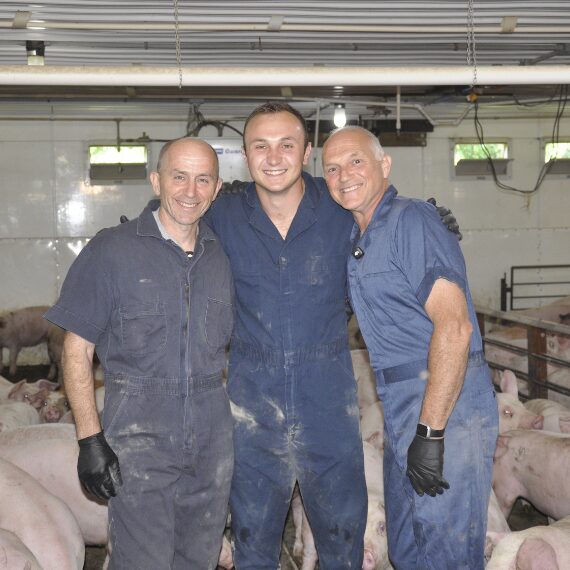
For the younger generation, the farm has been both a workplace and a classroom. They grew up doing chores, learning responsibility early, and figuring out how to work together. “At the time, you don’t always appreciate it,” says Korey Knoblock, who returned to the farm a few short years ago after finishing college. “But later you realize what it gave you.”
The lessons reach far beyond farming—how to work hard, rely on others, and step in when something needs to be done. “You figure out how to make it fun,” adds Trent Knoblock. “And you do it together.” Over time, that shared work built more than skills—it built relationships. Cousins became coworkers, uncles became mentors, and the farm became a place where connection grew alongside the operation itself.
That mindset continues to be passed down through example. As Trent puts it, “You’re not above any job.” It’s a simple idea, but one that shapes how each generation steps into the work and how leadership is modeled along the way.
Today, JRT Focus Farms is a diversified operation, finishing about 50,000 hogs and 2,200 head of cattle annually, while farming roughly 3,700 acres of conventional cropland. Much of what they grow feeds directly back into the livestock side of the business, creating a sustainable system where each piece supports the next. That approach is not only about efficiency, it also reflects stewardship. Practices like strip-till help protect soil health and water quality, which matters when the land you farm is the same place you call home. “We live here,” Trent says. “We want to take care of it.”
But the operation hasn’t always looked like it does today. One of the biggest changes on the farm didn’t come from expansion, it came from a challenge.
Turning Point
For years, JRT Focus Farms operated as a farrow-to-finish system, growing their sow herd to more than 1,200 head at its peak, all centered on the idea of building a centralized sow operation, and moving the rest of production off-site. “That was the goal,” Travis says. “To have our sows in one place.”
But over time, disease pressure, especially PRRS and PEDV, became increasingly difficult to manage. “It just kept coming back,” he says. “And it wears on you.” The toll wasn’t just financial. “At some point, it’s a hit to your spirit,” he adds. Letting go of the sow herd wasn’t easy. It had been a central part of the farm and a place where much of family life happened. “It took time to get everyone on the same page,” they admit.
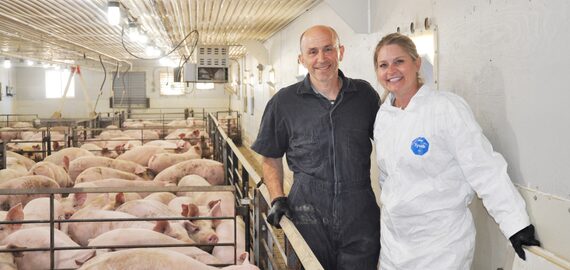
In the end, the family chose a different path. Instead of raising their own sows, they changed their approach to ownership, investing in Pipestone-managed sow farms and placing trust in others to manage the herd. At home, they shifted their focus—remodeling their sow barn into a 3,700-head feeder-to-finish facility. Across the operation, all nursery and finishing sites were able to transition to an all-in, all-out system, replacing continuous flow and helping break the disease cycle.
That shift allowed them to build on what they already had while adapting the farm to a system that better fit their operation. Looking back, the decision marked a clear turning point. “We should’ve done it earlier,” Trent says candidly.
The move brought more consistency in pig flow and herd health, along with a more predictable workload. It also created something just as valuable—time to invest in improvements, time for maintenance and projects, and time for family and community. Still, there were tradeoffs. “That was a great place to raise kids,” they say. “That’s probably what we miss most.” In the end, the decision came down to sustainability. “The way things were going, it just wasn’t going to work here.”
Evolving for the Future
As the operation has grown, so has the business side of farming. With more moving parts, the family has focused more on understanding their numbers, benchmarking performance, and planning for the future. Working with Pipestone has helped bring structure and clarity to those efforts, giving them a better understanding of where they stand and where they’re headed.
Through it all, faith and family remain at the center of JRT Focus Farms. Farming, as Travis sees it, provides plenty of opportunities to be reminded that “you do your best, and God does the rest.” Working together as a family takes communication, trust, and a shared commitment. As Korey adds, “Not every family farm stays together, and that’s something we’re grateful for.”
Looking ahead, the approach remains much the same as it has always been—steady growth, careful decisions, and a focus on making sure there is room for the next generation. “If someone wants to come back,” Trent says, “we want there to be an opportunity.” From one man’s small start to a thriving, multi-generational operation, JRT Focus Farms continues to move forward the same way it always has: a little here, a little there.
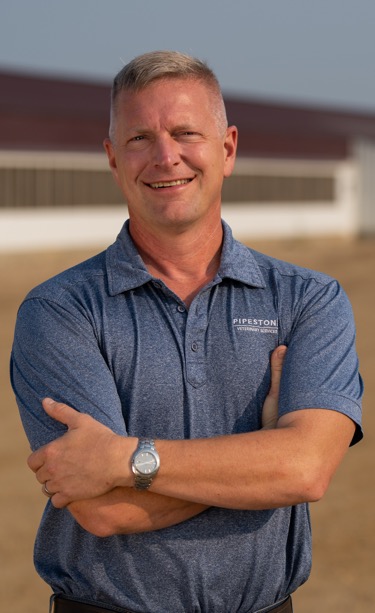
“I’ve had a front-row seat to the Knoblocks’ transition—from what worked at the time to what will carry the next generation forward. It hasn’t always been easy, but their unity has never wavered. They truly want what’s best for the family and for each other.”
– Hannah Walkes, President Pipestone Services